Strength forged in caves -- how Chinese communists led people's war against Japan's invasi
2025-08-26 10:19:55 來源:人民網 
2025-08-26 10:19:55 來源:人民網
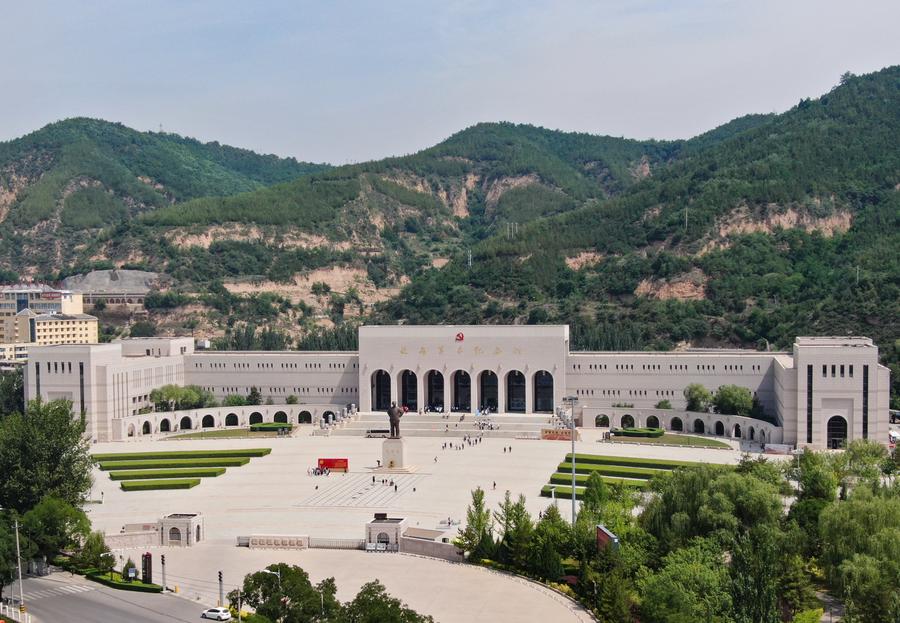
An aerial drone photo taken on June 27, 2023 shows the Yan'an Revolutionary Memorial Hall in Yan'an, northwest China's Shaanxi Province. (Xinhua/Zhang Bowen)
YAN'AN, Shaanxi Province, Aug. 25 (Xinhua) -- Even though Yan'an, located in northwest China's Loess Plateau, remains a relatively small city, it stands as an expansive museum for the living legacy of the Second World War, with sites that once were war-time military camps, command centers, army colleges, and schools to educate captured Japanese soldiers.
After the Long March (1934-1936), Yan'an served as the base of the Communist Party of China (CPC) leadership in around 10 years from 1937 to 1947. Its typical landscape of cave homes, dug out of barren earth, became the headquarters from which the CPC led the resistance against Japanese aggression.
American journalist Edgar Snow arrived in Yan'an in 1936 and left with a wealth of interview materials and photos, which later served as the basis for Red Star Over China, a book that introduced this "mysterious" stronghold to the world. Snow wrote of unmatched determination to fight the Japanese and described "a rocklike solidarity" among the people of the region led by the CPC.
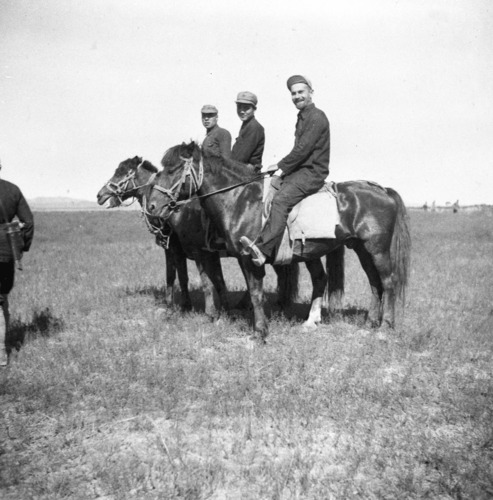
Undated file photo taken in 1936 shows American journalist Edgar Snow (1st R) on his journey for interviews in the northern areas of Shaanxi Province in northwest China. (Xinhua)
"As the war went on, Yan'an gradually became the command center, and the CPC-led troops and militias held down more than 60 percent of Japanese forces that invaded China," said Liu Fanchao, a researcher at Shaanxi Yan'an Cadre Academy.
As the war of resistance progressed, CPC-led bases spanned nearly one million sq km and were home to 100 million people, about one forth of the whole nation's population back then, she said.
A PEOPLE'S WAR
Despite its austere simplicity, Mao Zedong's cave dwelling in Yangjialing in Yan'an is a frequently-visited tourist destination. Here, amid the stark surroundings of the Loess Plateau, Mao articulated his famous dictum to visiting American journalist Anna Louise Strong that "All reactionaries are paper tigers."
"This statement underscored Mao's belief in the ultimate triumph of popular resistance over adversaries," said Liu Ting, a staff member of the Yangjialing site.
Immediately after the Sept. 18 incident in 1931, which was the beginning of Japan's 14-year invasion of China, the CPC made a declaration to oppose Japanese invasion. In 1935, the CPC advocated a united front against Japanese aggression.
"The CPC actively promoted and upheld the united front, rallied forces of the entire nation," said Cao Rong, a CPC history researcher at Shaanxi Yan'an Cadre Academy.
With Yan'an as the guiding core, the Eighth Route Army, the New Fourth Army, and other armed forces led by the CPC carried out guerrilla warfare in the vast rural areas.
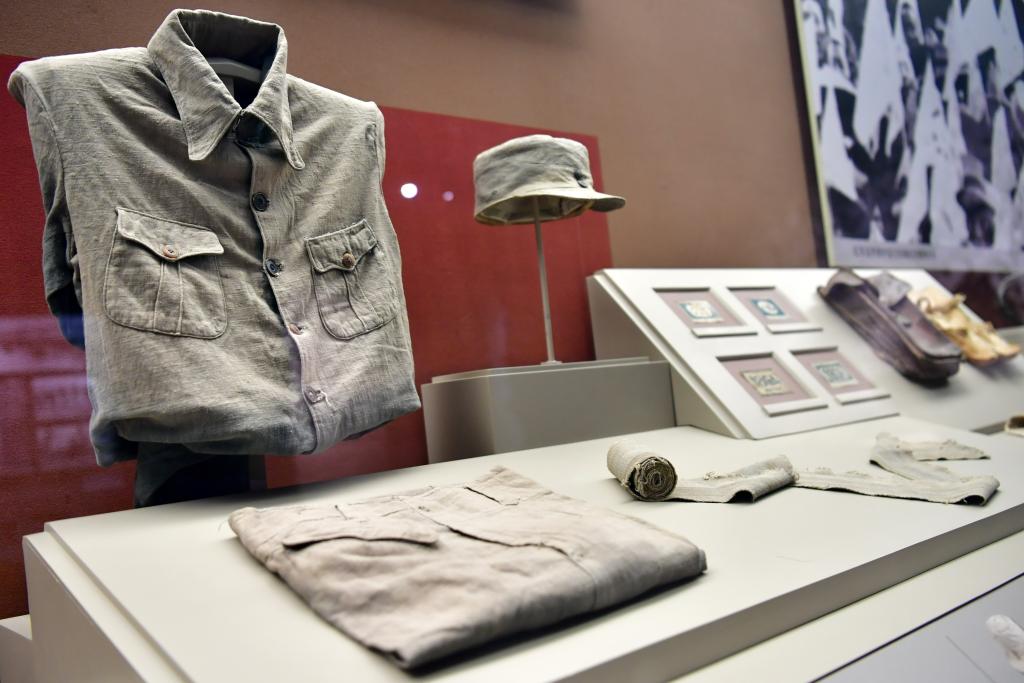
Exhibits are seen at the Taihang Memorial Museum of the Eighth Route Army in Wuxiang County of Changzhi, north China's Shanxi Province, Dec. 20, 2019. (Xinhua/Cao Yang)
In 1941, 14-year-old Zhang Xin joined the Eighth Route Army. "The Japanese occupied many cities, so we went to the countryside to establish base areas. The countryside was so vast," he recalled.
Veteran Liu Yichou, now 100 years old, still bears scars on his head, back and hands. "In every battle, one either got injured or killed in action," he recalled. "We had a company of around 150 men. We would have been lucky if 40 could make it back. Back then, all I wanted was to drive the Japanese invaders out of my country."
The Japanese troops soon realized the strength of their opponents. In the battle of Taihang Mountains, they attempted to annihilate the Eighth Route Army who led the attacks, and only found that they had to change the commanders. Japanese officer Norihide Abe, who was called an expert in mountain warfare, was called in. As soon as he arrived, he was killed, becoming the highest-ranking Japanese officer to fall to the Eighth Route Army.
One of the biggest difficulties the Japanese invaders encountered was that the villages were organized by the Eighth Route Army. Villagers pretended to obey the Japanese army, but secretly provided intelligence and transported supplies to the Eighth Route Army, and even took up weapons to fight alongside them.
In all base areas, the Party mobilized villagers to form defense teams. The number of militia members reached approximately 2.6 million and the Japanese invaders could not tell who was a civilian and who was a soldier.
Hisaichi Terauchi, then commander of Japan's North China Area Army, lamented the losses to the Eighth Route Army and militia, acknowledging that they had become more unified with vigorous operations. The so-called "security areas," he said, were only limited to areas within a few kilometers on both sides of major transportation routes.
Issei Hironaka, a historian at Japan's Aichi Gakuin University, noted that the Eighth Route Army firmly held down the Japanese troops on the North China battlefield, drained their strength, and prevented a swift end of the war.
If the Eighth Route Army had been suppressed, the war would not have dragged on for so long and the outcome would have been very different, he said.
"If the Japanese attack the West Indian Ocean, all our positions in the Middle East will be lost," then British Prime Minister Winston Churchill once warned. "Only China can help us to prevent that from happening."
The cost, however, was immense. To eliminate the CPC-led forces, the Japanese army launched brutal "mopping-up operations." During one such operation in May 1942, poison gas killed about 1,000 military personnel and civilians in Dingxian County, Hebei Province, in north China.
"Starting from October 1938, the Japanese invaders gradually shifted their main forces to combat the Eighth Route Army and the New Fourth Army, but it did not prevent the armed forces of the Party from expanding," said Li Zongyuan, curator of the Museum of the CPC.
By the end of the war, the people's army had grown to about 1.32 million and had eliminated more than 1.71 million Japanese and puppet troops, Li added.
"The Japanese army was trapped in a people's war in China and could not allocate more troops to the Pacific theater," said Liu Fanchao. "The CPC's perseverance in the war also inspired the people across the country and deterred those who wanted to surrender."
BEACON OF HOPE
The Phoenix Mountain, or Fenghuangshan in Chinese, in Yan'an, is also home to several earthen caves. Here in 1938, Mao Zedong wrote what would become a blueprint for winning the war.
The essay titled "On Protracted War" mapped the war in three stages, namely, strategic defense, strategic stalemate and strategic counteroffensive. "Chairman Mao's vision took him well beyond the caves to be acutely aware of the situation. He believed that people, not just armies, would win," Liu Fanchao said.
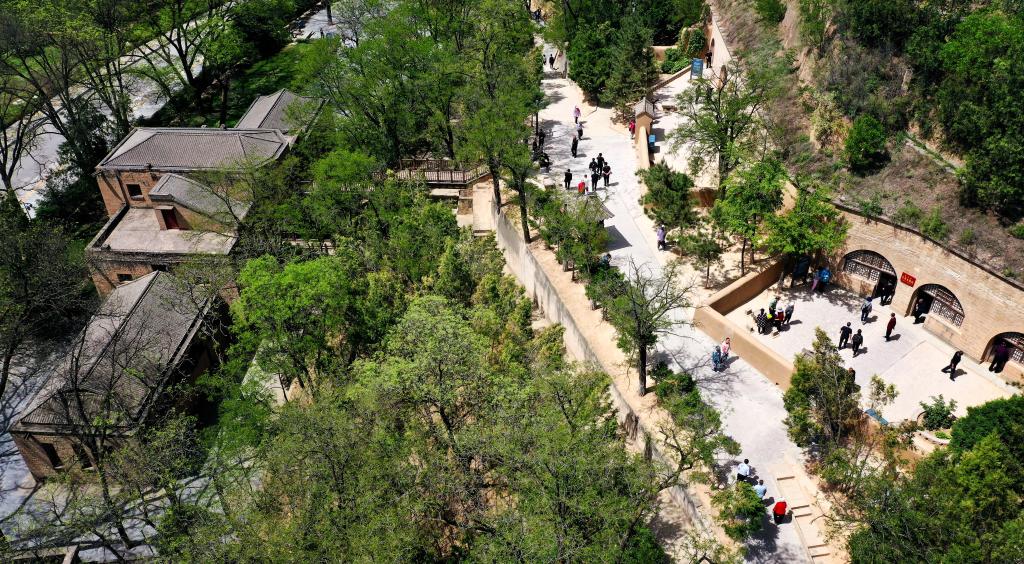
Aerial photo taken on May 8, 2021 shows a former revolutionary site at Yangjialing mountain in Yan'an City, northwest China's Shaanxi Province. (Xinhua/Liu Xiao)
The Yan'an period was a crucial stage in the development of Mao Zedong Thought, an ideology that served as the theoretical banner for guiding the war to victory and even constructing a New China, making Yan'an a "beacon" of China's future.
As a political center, Yan'an drew thousands of writers, artists, scientists and hopeful youths who trekked through enemy lines. Institutions in the city trained thousands of talent seasoned in guerrilla warfare.
"The gates of Yan'an stand open all day," wrote poet He Qifang in 1938. "Young people arrive, luggage on their backs, hope in their eyes."
Writing about that period, British historian Rana Mitter noted that the powerful status of Yan'an as a beacon of radical resistance attracted large numbers of migrants, some 100,000 between 1937 and 1940.
U.S. President Franklin D. Roosevelt had talks with Snow and came to understand the situation in Yan'an. His administration later sent a U.S. Army Observation Group, or the Dixie Mission to Yan'an in 1944.
The Dixie Mission staff's "cave hotels" remain in today's Yan'an Middle School, showing visitors the China-U.S. cooperation of the time in fields of communications, transportation, intelligence, guerrilla warfare, weather observation, demolition, and weapon development. The U.S. reports gave positive comments on what happened in Yan'an, and highlighted its democratic political practices.
In 1942, a rectification movement against subjectivism, sectarianism and stereotyped Party writing was launched across the whole Party. "Advancing the building of the Party as a major undertaking during the war provided the political guarantee for it to serve as the pillar in the war of resistance," said Lu Xiaona, a lecturer at the School of History and Culture, Shanxi University.
"The CPC, which championed perseverance and hope throughout the war, showed the world that a nation united could defeat any invader," she added.
編輯: 馬路遙
 以上文章僅代表作者個人觀點,本網只是轉載,如涉及作品內容、版權、稿酬問題,請及時聯系我們。電話:029-63903870
 府谷:一座邊塞將城的千年傳奇
 舌尖盛宴點亮暑期“食”光
 暑期旅游熱
暑期旅游熱 漢中南鄭:綠水青山間走出致富
 西安:一鍵穿越!于千年古都領略
 西渝高鐵重慶段開始架梁施工
 “走讀絲路·行閱中亞”2025跨國圖書出版交
 寶雞隴縣49件國寶級文物驚艷亮相澳大利亞
  西鳳酒亮相2025韓國葡萄酒與烈酒博覽會
 High-tech exhibits displayed at 9th Chin