Global auto giants look to China for future vision
2025-06-09 16:48:42 來源:人民網 
At the Auto Shanghai show in April, an executive of Volkswagen — one of the world's biggest auto manufacturers — made a frank admission that the German giant had misfired on its country strategy for China.
"To be very honest, we didn't have the right product strategy or the right approach to drive the business in China," Oliver Blume, chairman of the board of management of the Volkswagen Group, told China Daily.
He was referring to the situation when the same event was held two years ago.
"But at this auto show, we're not just talking about strategy or plans on paper — we're showcasing real results, and that makes me very proud of what the teams have accomplished," said Blume.
The German automaker's long and profitable association with China began in October 1984 when it inked a deal with the Shanghai Automobile &Tractor Company to begin a joint venture, Shanghai Volkswagen. Now known as SAIC Volkswagen, it is the oldest extant automotive partnership in China.
Despite the Germans' initial concerns that the fledgling China operation could not produce even "one Volkswagen-standard car" the first model of the joint venture, the Santana, rolled off the assembly line in late 1985.
German technology and management, coupled with China's reform and opening-up and local workers' diligence, was the right formula for success. The Santana was a triumph, and for more than 30 years Volkswagen — joined by other foreign automakers such as Peugeot, Fiat, Toyota and Hyundai — rode on the path of prosperity created by China's ongoing development and modernization.
By 2009, China had become the world's largest vehicle market, and non-Chinese brands accounted for 56 percent of total vehicle sales, according to the China Association of Automobile Manufacturers.
But, the peak for overseas auto manufacturers in China was followed by a decline as the industry entered the era of NEVs.
Volkswagen sales tumbled from 3.85 million units in 2020 to 2.92 million units in 2024. In the meantime, Chinese automaker BYD's sales skyrocketed from 427,000 units in 2020 to 4.27 million units in 2024.
Volkswagen wasn't alone. South Korean automaker Hyundai, the world's third-largest carmaker, delivered 507,000 units in China in 2020, but last year its sales shrank to 157,000 units.
General Motors, the No 1 carmaker in the United States, saw its sales in China plunge from 2.9 million units to 1.83 million units over the same period.
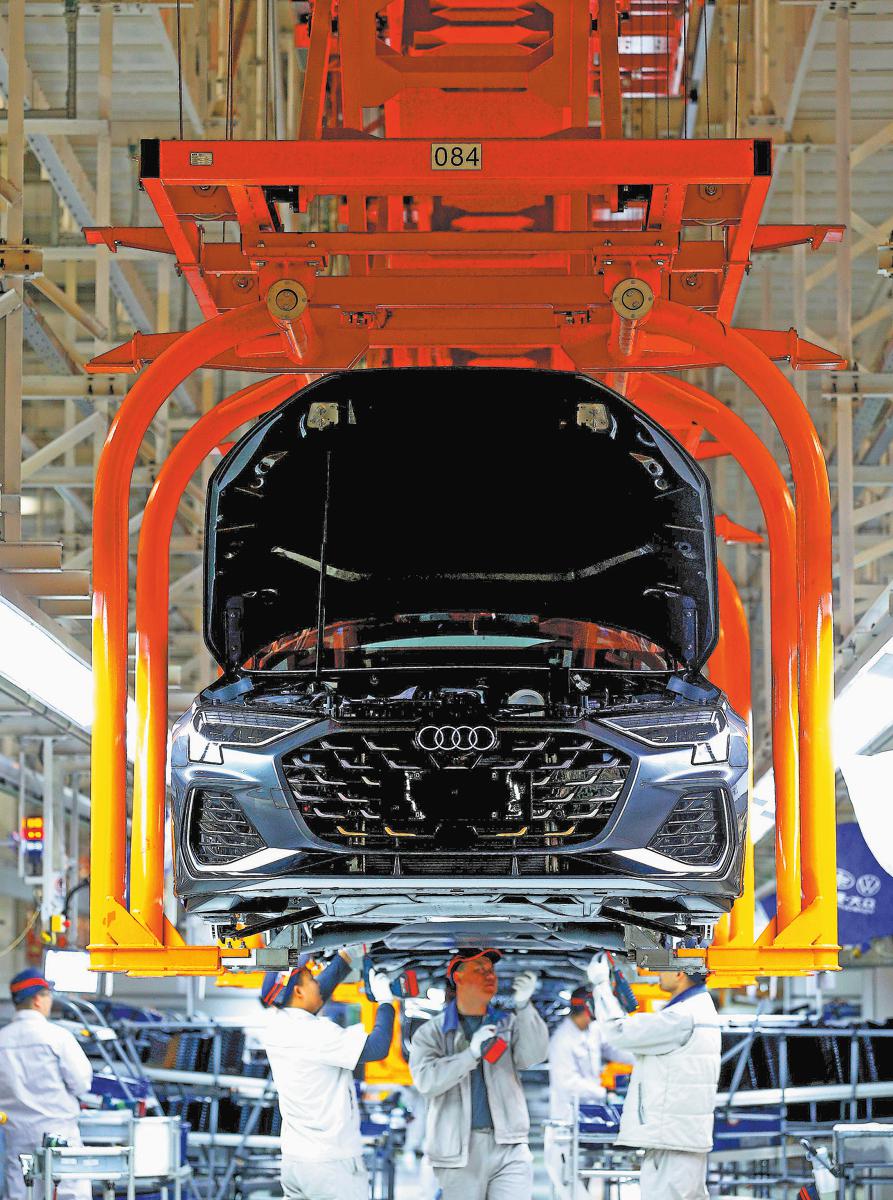
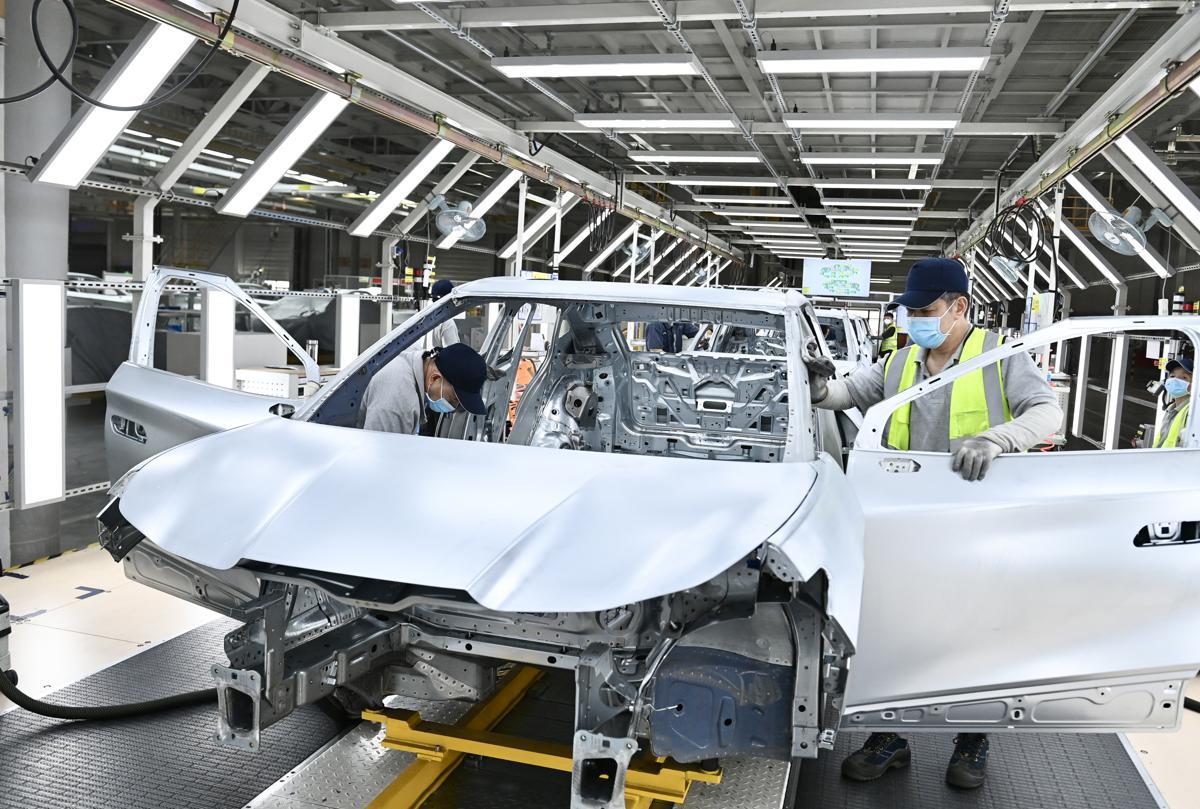
Workers assemble a car at the FAW-Volkswagen production base in Qingdao, Shandong province, on April 15. (Liang Xiaopeng/Xinhua)
Strategic rethink
In recent years, Volkswagen has come to realize that developing cars in Europe and bringing them into China no longer works, as local rivals are coming up with completely new products at a super fast speed and car buyers are young and tech-savvy.
Ralf Brandstaetter, CEO of Volkswagen Group China, expressed those ideas in late 2023 in Hefei, capital of East China's Anhui province, where the German company has built an R&D facility dedicated to smart new energy vehicles (NEVs).
With an investment of 1 billion euros ($1.09 billion), Volkswagen China Technology Company is the carmaker's largest development center outside Germany. The center is creating an electric vehicle (EV) platform specifically for the Chinese market and to meet the demands of Chinese customers. The first model is scheduled to roll out in 2026.
"We will bring the platform to market maturity in just 36 months. This means that we are reducing the development time by around a third," Brandstaetter said.
One key driver of efficiency is greater involvement of local suppliers. Volkswagen said around 1,100 Chinese suppliers are involved, and the localization rate will gradually be increased to 100 percent.
Volkswagen calls it the second wave of "localization" in the country. In the first wave, the company purchased components from international suppliers' plants in China, which nevertheless required going back and forth with the automaker's headquarters in Germany, a company executive explained.
But now, Volkswagen sources components directly from Chinese companies and involves them in the early stages of development, which saves time and improves integration.
This year's Auto Shanghai show saw several new Volkswagen models — including the ID. AURA, the ID.ERA and the ID. EVO — on display that offered a glimpse into the company's electric vehicle-focused future.
Starting from 2026, over 20 state-of-the-art NEVs will be launched, including battery electric vehicles, plug-in hybrid electric vehicles and extended-range electric vehicles, to suit differing customer demands in China, said the carmaker.
More importantly, these models are not engineered in Germany, but developed with "Chinese solutions", making them more appealing to local customers.
The carmaker launched its "in China for China" strategy in 2023. "For us, 'in China, for China' is not just a slogan — it's our execution mode," Brandstaetter told China Daily at the auto show.
Despite Volkswagen's renewed confidence, the challenges ahead remain formidable and Brandstaetter is acutely aware of the realities, especially the fierce competition faced from Chinese automakers.
While the new generation of Volkswagen models tailored for the Chinese market is just around the corner, Brandstaetter remains cautious. "We are confident, but I think the competition is tough here in China, and this will be an ongoing challenge in the coming year," he said.
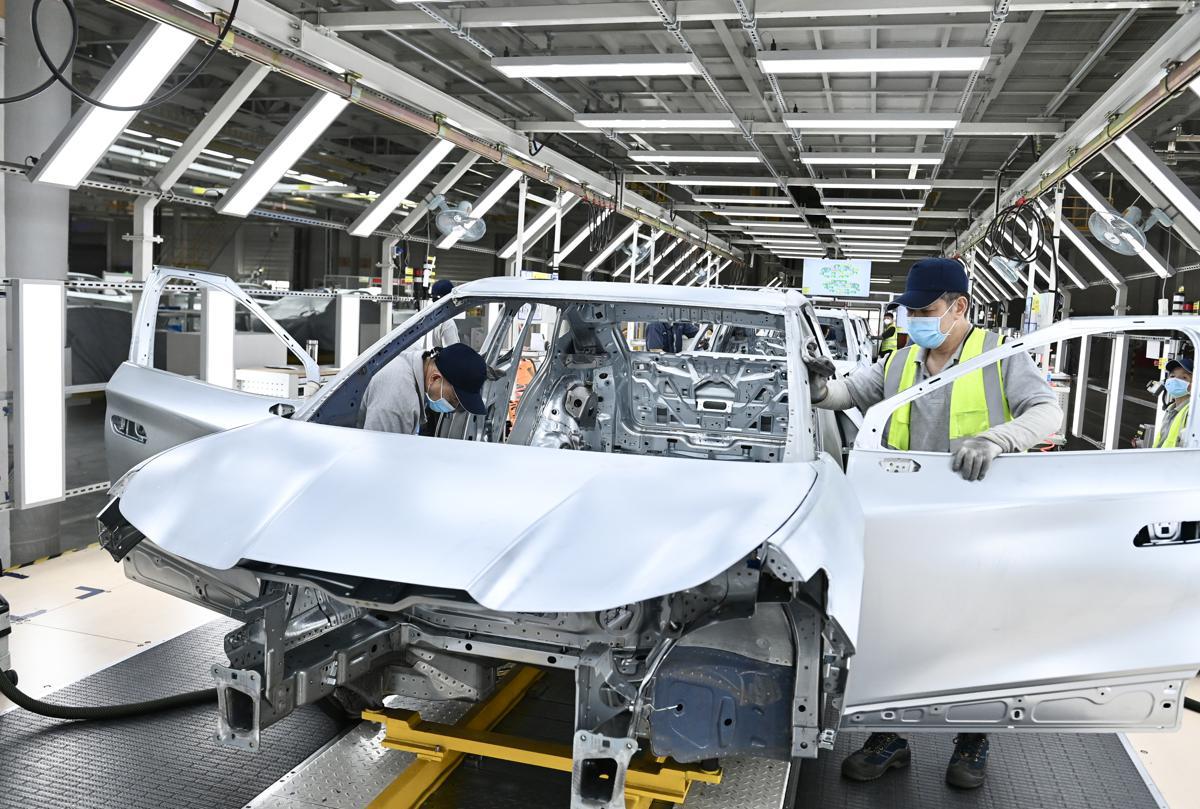
Staff members work at the Volkswagen Anhui Modular Electric Drive Matrix plant in Hefei on Sept 25. (Han Suyuan/China News Service)
'Inventing' in China
As the world's largest and most fiercely competitive automotive market, China is redefining the global car industry — not just as a sales powerhouse, but increasingly as the epicenter of innovation, research and development, and manufacturing excellence.
"The market here is not just the largest in scale — it is the most innovative," said Christophe Perillat, CEO of French auto parts supplier Valeo.
His company, which entered China in 1994 and now employs over 18,000 people across 27 production plants and 13 R&D centers, is doubling down on localization efforts.
Valeo plans to open a new R&D hub in Shanghai focused on advanced driver-assistance systems and a production facility dedicated to "smart driving" technologies.
Perillat stressed that Valeo is "inventing in China" — not merely importing global technologies.
Some 4,500 engineers work locally, with a large proportion of software developers, underscoring the growing importance of software and AI in automotive innovation.
This trend is echoed by other industry players.
Auto parts giant Continental unveiled the name of its new automotive group, Aumovio, at the Shanghai show, signaling a strategic shift to position China at the center of global mobility innovation.
Philipp von Hirschheydt, CEO of Aumovio, said "I see (this launch) as a tribute to China and a recognition of the key role this market plays within our global organization."
He said the local team has more autonomy because of the need for faster decision-making in a market where development cycles are shorter.
German auto parts provider Schaeffler is celebrating its 30th anniversary in China, where it now employs 19,000 people across 17 factories and six research and development centers.
"China is no longer just a growth market. It's becoming the epicenter of future automotive technology," said Matthias Zink, CEO of Schaeffler's automotive technologies division.
"We believe the future of mobility is being written in China," Zink added.
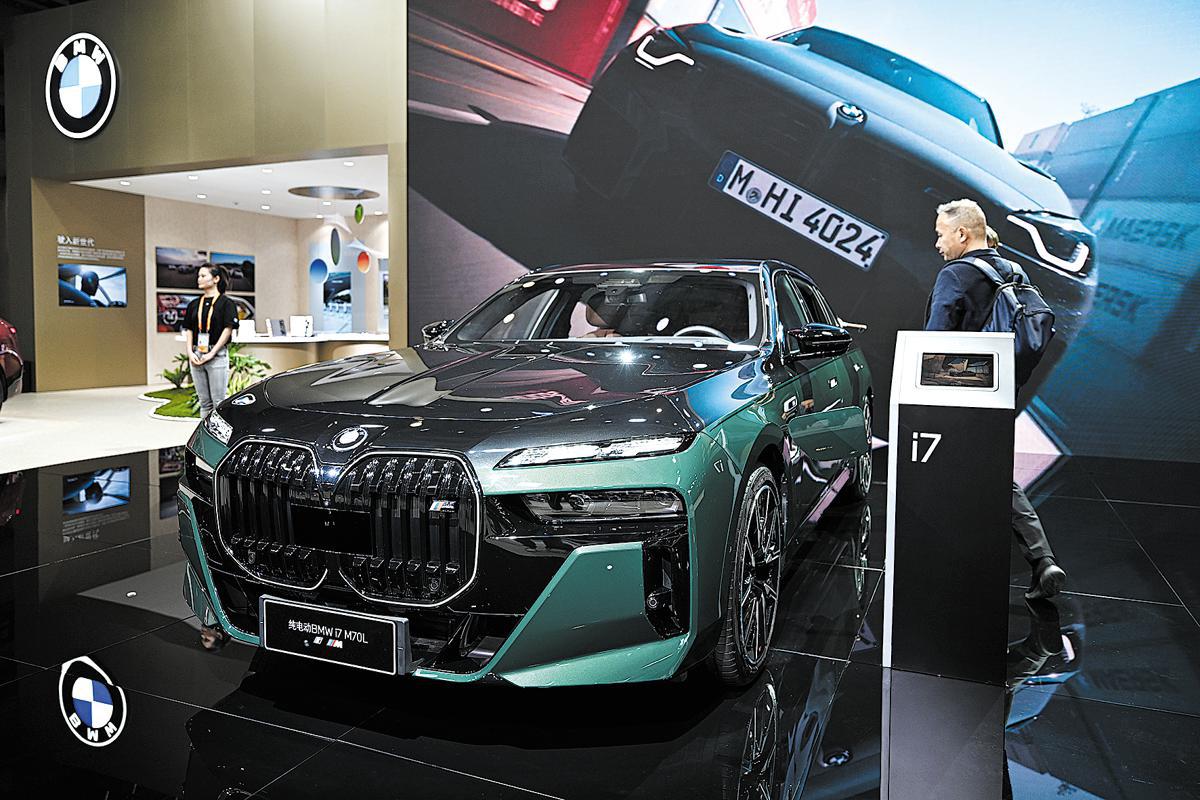
A BMW i7 electric luxury sedan is on display during the seventh China International Import Expo in Shanghai on Nov 7. (Xin Yuewei/Xinhua)
Chinese tech's role
One of the most important assets for all global auto companies is China's thriving tech related to the industry.
Automotive AI, smart in-car functions, and advanced driver assistance systems (ADAS) have become key battlegrounds where Chinese companies lead, or collaborate closely, with international players.
In April, BMW announced integration of the locally developed AI model DeepSeek into its China-made Neue Klasse vehicles from 2026. The move marked a significant milestone in embedding Chinese AI into global products.
The Neue Klasse models will also feature AI agents developed in partnership with Alibaba, that will offer digital manual support and travel planning tailored for Chinese consumers.
Mercedes-Benz's long-wheelbase CLA — with ByteDance's Doubao large language model — further exemplifies how global brands tap Chinese AI to enhance the user experience.
"That is why you have to be in China," said Ola Kaellenius, chairman of the board of management at Mercedes-Benz AG in an interview with China Daily. "You have to be in China not just because of the access to the market but because of the technology, (and) innovation."
Kaellenius described China's role as a source of "inspiration not just to delight customers in China, but to use what we learn and innovate here also for the rest of the world".
Chinese smart-driving companies like Horizon Robotics, Momenta, and Huawei have become key technology partners.
Volkswagen's largest single investment in China was a 2.4 billion euro deal with Horizon Robotics in 2022, followed by the creation of a joint venture, Carizon, which will supply driver-assistance systems from 2026.
Volkswagen's premium Audi marque has partnered with Huawei to provide driver-assistance systems for its gasoline-powered A5L sedans and upcoming electric Q6L e-tron SUVs.
Honda, meanwhile, is co-developing next-generation ADAS with Momenta, and adopting DeepSeek AI technology for its electric Ye Series, a major pivot to harness Chinese tech capabilities.
UBS automotive analyst Paul Gong said: "China has evolved from a market with potential to the largest and most profitable market, then into the most competitive manufacturing hub, and gradually into a training ground and fitness center — and now, into a 'brain', the core of research and development."
The rapid localization of R&D and production, combined with deep collaboration with Chinese tech firms, is redefining innovation models for global automakers. Auto manufacturers that harness Chinese innovations in the industry will have a greater chance of restoring their markets and grabbing early advantages of the tech, analysts said.
The International Energy Agency predicts that NEVs will account for over 40 percent of global car sales by 2030. In China, the market share could reach 80 percent.
It is too early to predict the fate of overseas carmakers in China's NEV era, as most of their new models will not hit the market until 2026, which could be a make-or-break year for many of them.
Volkswagen's Blume, nonetheless, said he enjoys competition, likening it to sports, where competition helps improve one's performance. "If you aren't improving week after week, that means you are lazy — and that changes us, and makes us better," he said.
Blume said China is like a "fitness center" for the global automotive industry, where global carmakers can sharpen their competitive edge by operating in this market.
"Now, we feel fitter than we did two years ago. The customer will decide who wins in the market. You don't need to fear the battlefield when you're prepared," he said.
編輯: 馬路遙
 以上文章僅代表作者個人觀點,本網只是轉載,如涉及作品內容、版權、稿酬問題,請及時聯(lián)系我們。電話:029-63903870
 各地迎來“五一”假期出行高
 西安:“陽光課間”賦能學生身
 西安:梅紅柳綠春色至
 黃土地上的社火少年
 華山迎來新春旅游高峰
 多彩活動歡度蛇年新春
 China-Laos Railway boosts durian exports
 Global auto giants look to China for fut
 Discover the beauty of nature in SW Chin
 China's trade, auto data highlight brigh