Memories of a transformative war reveal a tale of three Chinese cities
2025-08-29 09:43:38 來源:人民網 
2025-08-29 09:43:38 來源:人民網
BEIJING, Aug. 26 (Xinhua) -- War veteran Zhang Xin will never forget the day Japanese aggressors surrendered. Yan'an, the revolutionary base in northwest China, was illuminated by many lanterns, while the sounds of cheers, firecrackers, gongs and drums echoed through the night.
In southwest China's Chongqing, pilot Long Qiming took his family to a photo studio for a group portrait, while in Shenyang in northeast China, soldier Yang Huafeng whispered: "Dad, mom, we've won at last."
Yan'an, Chongqing and Shenyang form an obtuse triangle on China's map. Like hundreds of other cities, they each hold memories of the Chinese People's War of Resistance Against Japanese Aggression -- fought from 1931 to 1945.
"Many of my comrades died fighting the invaders," Yang said. "The victory was hard-won."
In 1945, China triumphed after 14 years of unyielding struggle, which left a tremendous cost of 35 million military and civilian casualties. During the World Anti-Fascist War, China tied down and fought the bulk of Japan's forces -- eliminating more than 1.5 million enemy troops.
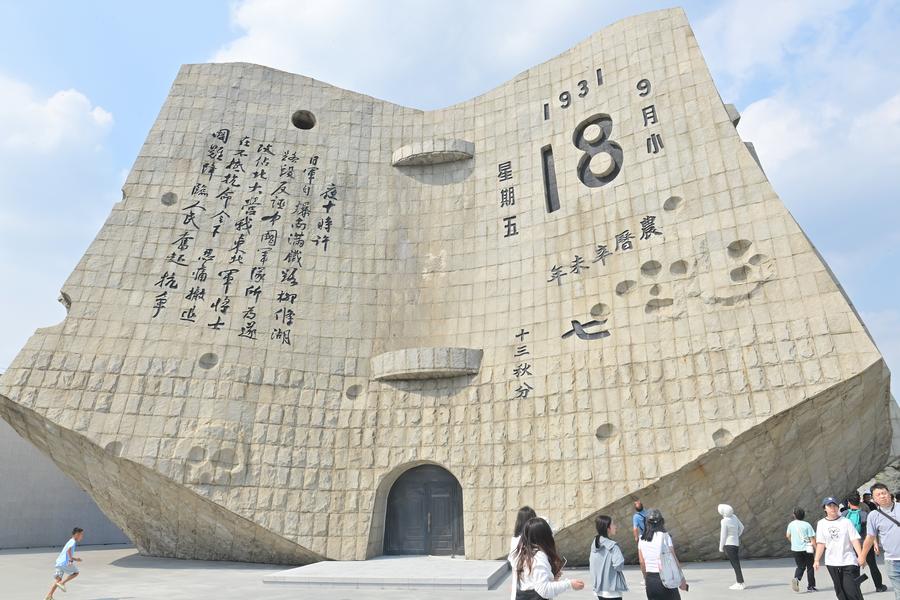
People visit the 9.18 Historical Museum in Shenyang, northeast China's Liaoning Province, Aug. 12, 2025. (Xinhua/Wu Qinghao)
BEGINNING OF TRIBULATION
On Sept. 18, 1931, Japanese troops blew up a section of railway under their control near Shenyang, capital of Liaoning Province, and blamed Chinese soldiers as a pretext for launching an attack. That night, the Japanese bombarded nearby barracks, marking the beginning of 14 years of invasion.
The ruins of these barracks have been preserved. Located in a quiet alley, the rebuilt gray gate bears no bullet holes. But this was where the first shots were fired in the war of resistance, at a time when Nazi leader Adolf Hitler was still laying the foundation for his "vision" for post-depression Germany.
"Japan was the first hotbed of the World Fascist War," said Li Donglang, a professor with the Party School of the Communist Party of China (CPC) Central Committee (National Academy of Governance). "Therefore, the September 18 Incident marks the start of global fight against the Fascists."
After seizing Shenyang and then the whole Liaoning, the Japanese soon took over the entire northeast China including also Jilin and Heilongjiang. But resistance never ceased.
In the busy downtown area of Shenyang, an alley containing a brick gatehouse seems unremarkable among the towering buildings. But this is Fu'an Lane -- once the location of a local CPC committee, where on the second day after the September 18 Incident -- a declaration was issued by the CPC. It was recognized as the first declaration against the Japanese invaders.
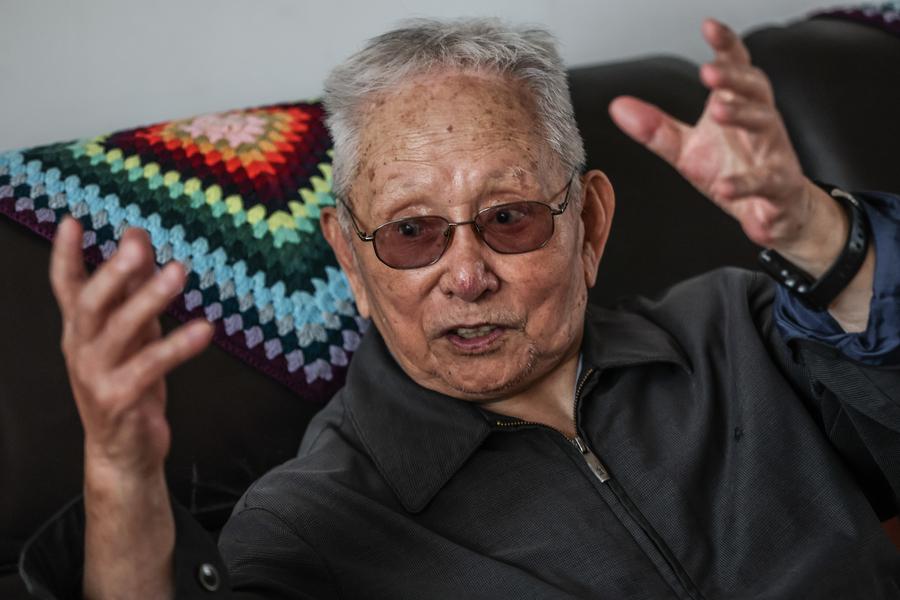
War veteran Yang Huafeng tells the story of his younger years in Shenyang, northeast China's Liaoning Province, June 30, 2025. (Xinhua/Pan Yulong)
Yang Huafeng, born in 1933, still remembers the bravery of guerrillas in northeast China then. "They were just two or three hundred at most. Whenever they saw a small Japanese unit, they wiped them out," he recalled. Lacking weapons, the fighters made their own or used captured Japanese arms.
Yang, who later joined the guerrilla forces, was from a village in Heilongjiang Province. His father was seized by Japanese troops and forced to work as a laborer. During interrogation, his father declared: "I am a Chinese!" This resulted in him being beaten to death. His mother was shot dead when she tried to rescue belongings from their burning home.
In 1936, Zhang Xueliang, then commander of China's northeast army who retreated from Shenyang, took Kuomintang leader Chiang Kai-shek hostage and demanded that he stop the civil war and unite with the CPC against Japanese aggression.
FORTITUDE AND SACRIFICE
In 1937, the Japanese attacked Beijing, marking a full-scale invasion of China.
On the main battlefields, impoverished China was no match for an industrialized Japan, which boasted a steel output more than 140 times greater than that of China.
Following Beijing, other major cities -- such as Shanghai, Nanjing and Wuhan fell in quick succession. As a consequence, the national capital was moved from Nanjing in the country's east to Chongqing in the southwest.
Mass migration ensued, eclipsing even the scale of Dunkirk. "Some 80 million or even close to 100 million Chinese -- approximately 15 to 20 percent of the entire population, were on the move," wrote British historian Rana Mitter in his book "Forgotten Ally: China's World War II, 1937-1945."
Refugees were evacuated from Nanjing but 300,000 people who failed to escape were slaughtered by the Japanese invaders. Meanwhile, the likes of universities, factories and research institutes from the coastal areas relocated to the southwest, enabling them to continue their work in resistance.
In a bid to subjugate China, Japanese warplanes bombed Chongqing for six years -- killing and wounding over 32,000 residents and destroying 17,000 houses.
Su Yuankui, now 92, remembers June 5, 1941, as the day he lost his two sisters in Chongqing. Only eight at the time, Su was having supper when a siren wailed. His family rushed to a shelter, but as more people poured in, he was separated, crushed in the crowd, and then fainted.
"When I woke up the next day, I was surrounded by corpses," he recalled. His two sisters were among the over 1,000 victims who died of suffocation and stampede in what was later described as one of WWII's deadliest air-raid tragedies.
To survive Japanese bombing raids, Chongqing residents dug more than 1,600 air-raid shelters across the city, one of the largest such endeavors during the WWII. At the site of a giant crater, a monument was later erected bearing large characters meaning Spiritual Fortress.
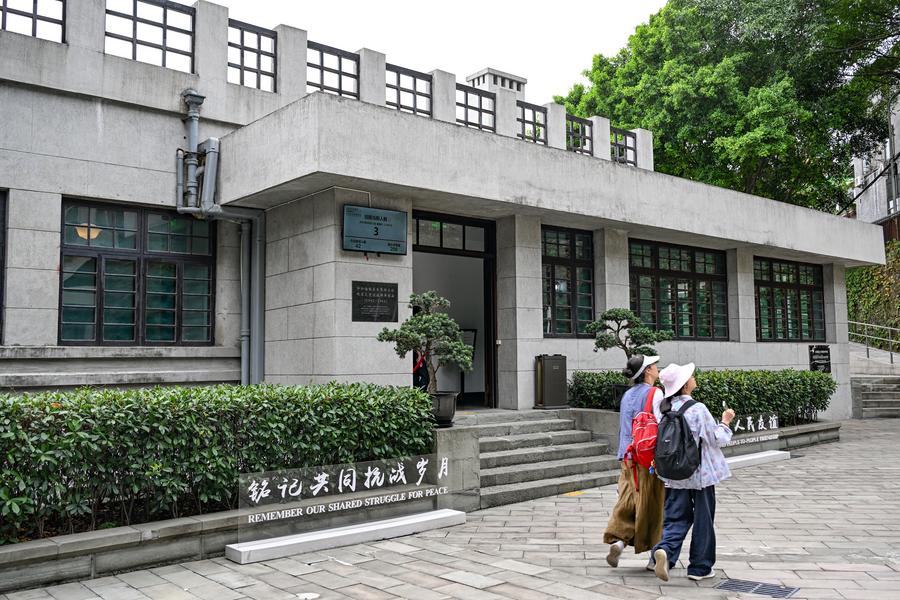
People visit the Chongqing Stilwell Museum in Yuzhong District of Chongqing, southwest China, Aug. 23, 2025. (Xinhua/Wang Quanchao)
Chongqing became the command center of the World Anti-Fascist War in the Far East. In its downtown area is a gray-brick house, which is the former residence of U.S. General Joseph Stilwell, commander of U.S. forces in the China-Burma-India Theater. This was where Stilwell coordinated with Chinese leaders.
Key decisions were made there -- including dispatching 100,000 Chinese expeditionary soldiers to Myanmar to fight against Japanese forces with the Allies, and launching the Hump airlift, a vital airlift route over the Himalayas and the primary way the Allies supplied China between 1942 and 1945.
Long Wenwei's father, Long Qiming, originally from Hong Kong, joined the Chinese air force. "My father said they flew the Hump almost daily. Bad weather and Japanese fighters brought down many planes," revealed Long, now 81. Of the 28 Chinese trainees in his father's group, only a few survived. "Many who had breakfast with him failed to come back in the evening."
Later, his father was assigned to a bomber unit. In one raid against a Japanese supply depot in Myanmar, he dived low to release his bombs with precision. When he returned, the tail of his aircraft was riddled with 14 bullet holes.
LIGHTHOUSE OF HOPE
In a cave dwelling on a hill in Yan'an, Mao Zedong wrote his famous essay "On Protracted War," which became the strategic guide for resistance. The enemy cannot gobble up the whole of China, though it can occupy many parts for a period of time. China cannot quickly oust the enemy, but most of the land will remain ours. In the end, the enemy will be defeated, but only after a difficult struggle, Mao wrote.
"During the war, the CPC advanced the strategy of all-out resistance and protracted war, leading guerrilla warfare, building base areas and mobilizing the masses," said Tan Huwa, professor at Yan'an University.
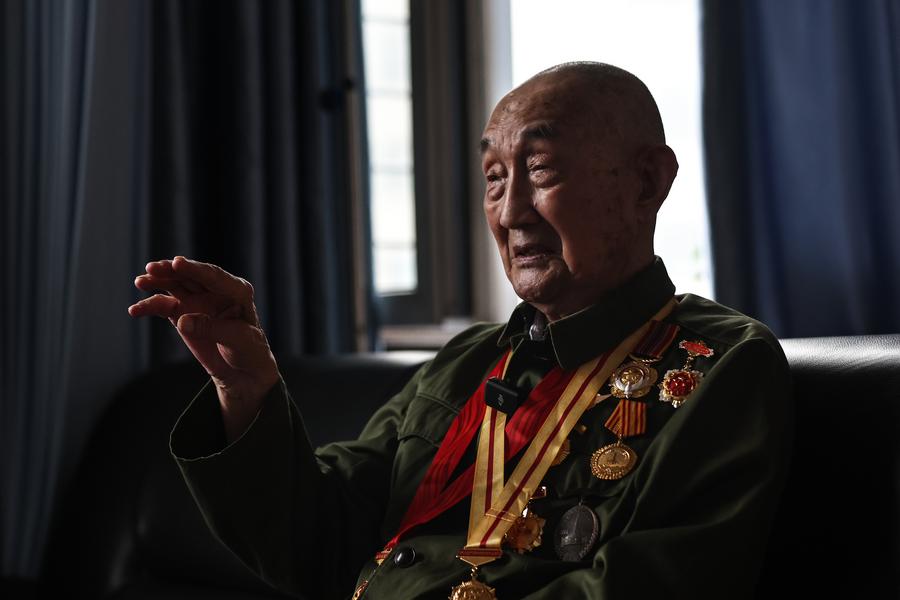
War veteran Zhang Xin tells the story of his younger years in Shenyang, northeast China's Liaoning Province, July 2, 2025. (Xinhua/Pan Yulong)
In 1941, then-14-year-old Zhang Xin joined the Eighth Route Army, with the Chinese fighters employing guerrilla tactics.
"The Japanese occupied many cities, so we went to the countryside to establish base areas -- the countryside was vast," he said. "By day we were in the villages, at night we fought the enemy."
Poorly armed and short of guns, the Chinese force still pressed on. "Officers always led from the front," Zhang said. "I was young, and when retreating, the commander would sometimes give me his horse to ride."
His unit endured two massive sweeps in north China. In the worst, they marched two days and nights to escape. Many comrades were killed. Of an initial 1,500 men, fewer than 800 remained.
In Laishui of Hebei, 10 soldiers stayed behind to cover the retreat. Choosing death over capture, they held their ground before making a final, desperate leap from a cliff.
But the outgunned Chinese managed to tie down large numbers of Japanese troops, reassuring local villagers that their army was still fighting, keeping hope alive, Zhang said.
"The CPC-led forces waged vigorous guerrilla warfare behind enemy lines, expanding revolutionary bases and complementing the main front," said Tan.
"As the war went on, Yan'an gradually became the command center, and the CPC-led troops and militias held down more than 60 percent of Japanese forces that invaded China," said Liu Fanchao, a historian specializing in CPC history in Yan'an. Toward the end of the war in 1945, CPC-led bases spanned nearly one million square kilometers and were home to about 100 million people.
When Zhang finally reached Yan'an, he saw new vitality -- the Great Production campaign for self-sufficiency, the direct election and democratic governance, the arrival of progressive youth from across the country, and foreign correspondents like Edgar Snow, author of "Red Star Over China."
"At Yan'an, people saw the spirit of hard struggle and determination to fight until the end. They believed this was where China's hope lay," said Li Zongyuan, curator of the Museum of the CPC.
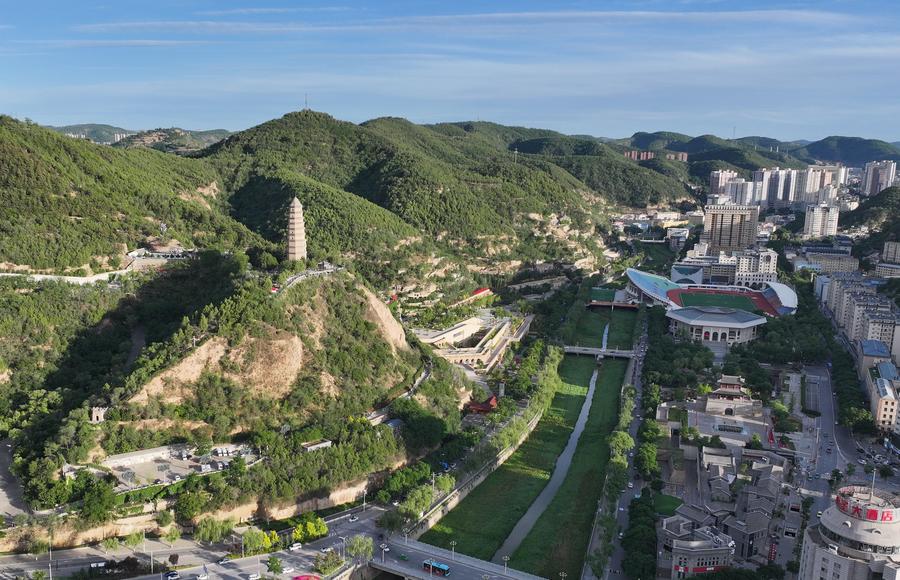
An aerial drone photo shows a cityscape of Yan'an, northwest China's Shaanxi Province, June 3, 2025. (Xinhua/Zhang Bowen)
ENEMY'S FALL, NATION'S RISE
The complete triumph of WWII, many historians argue, marks the start of China's rise. "Since 1840, China had suffered repeated military invasions by imperialist powers, and all those wars ended in China's defeat," said historian Wang Jianxue.
"The war against Japanese aggression, however, united the entire nation for the first time and ended with a total victory, which helped us regain confidence," he said.
"The victory was the starting point for the Chinese people to move toward independence, prosperity and progress," he said. China became a founding member of the United Nations and a permanent member of its Security Council -- marking the first time in modern history that China participated in shaping the international order as a major power.
Pilot Long Qiming, after his retirement, settled in Chongqing, where he participated in commerce work, taking advantage of opportunities generated by China's reform and opening-up drive starting in the late 1970s. "He helped handle the city's first-ever steel export of 5,000 tonnes. It was such a rewarding moment," said his son Long Wenwei.
Today, Chongqing serves as a pivotal gateway for foreign trade in China, facilitated by China-Europe railway services and the New International Land-Sea Trade Corridor. The area where the war monument stands has turned into bustling business district where customers sip Colombian coffee or shop for chic couture from Europe.
Veteran Yang Huafeng was happy to see his grandson admitted to a prestigious postgraduate program at a university in Hong Kong, while his granddaughter returned to China after studying in the United States and now works at a German automobile manufacturer in Shenyang.
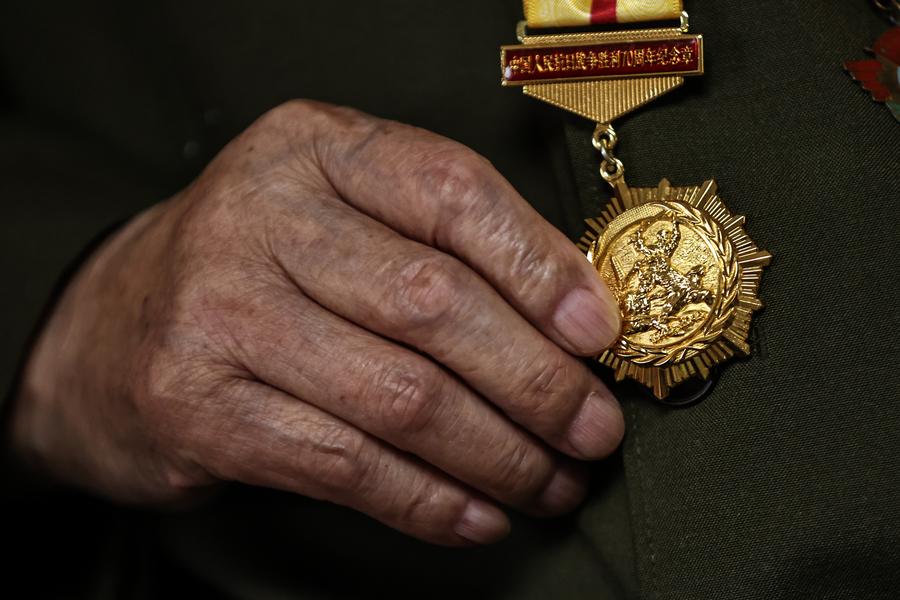
War veteran Yang Huafeng shows a commemorative medal he was awarded in Shenyang, northeast China's Liaoning Province, June 30, 2025. (Xinhua/Pan Yulong)
Veteran Zhang Xin later became one of the first ground crew members of the Chinese Air Force. He has witnessed China's leap in aviation -- the country now not only manufactures its own large aircraft but has also achieved intelligent aircraft production -- with robots being deployed in the manufacturing process.
"The wartime memories taught us a hard lesson -- backwardness leaves one vulnerable to attacks. The same applies to the field of science and technology. We must outperform others and accelerate technological innovation," said Ha Enjing, a manager at Siasun Robot &Automation Co., Ltd., a leading robotics firm in Shenyang. Now brands like Rolls-Royce are among its clients and its products are sold to over 40 countries and regions.
The once embattled Yan'an is now full of vigor. In the southern part of the city, where the self-sufficiency campaign was launched during the war -- towns and villages are developing booming businesses. Mafang Village, once poverty-stricken, now banks on hotel and food-processing projects. Last year the village's per capita disposable income of its farmers was roughly 23,000 yuan (about 3,216 U.S. dollars), up 13,000 yuan in less than 10 years.
In his late 90s, Zhang Xin still hopes to revisit the Yan'an cave dwellings where he once lived during the war. "My comrades-in-arms are gone, but their aspirations live on," he said. "I want to tell them that the younger generation is building a stronger China -- one that will be bullied by none, and one that will contribute to safeguarding world peace."
編輯: 馬路遙
 以上文章僅代表作者個人觀點,本網只是轉載,如涉及作品內容、版權、稿酬問題,請及時聯系我們。電話:029-63903870
 以盛唐婚典為引 活化傳承中
 以“悅跑”之力繪就文明實踐
 恢復通車!灞河2號橋“煥新”
 秋賞葫蘆趣滿懷
 歷史糧倉變身游客打卡新坐標
 府谷:一座邊塞將城的千年傳奇
 “走讀絲路·行閱中亞”2025跨國圖書出版交
 寶雞隴縣49件國寶級文物驚艷亮相澳大利亞
 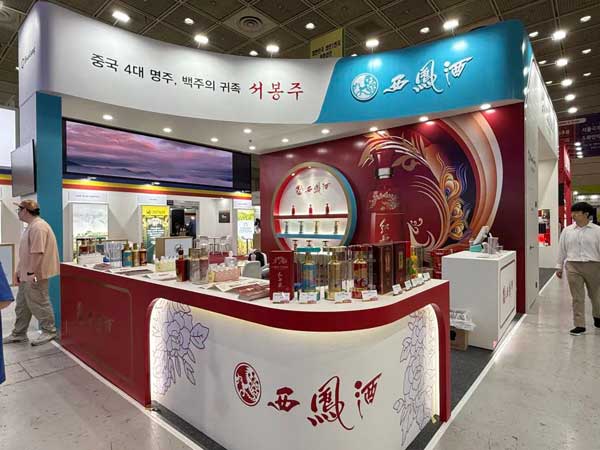 西鳳酒亮相2025韓國葡萄酒與烈酒博覽會
 High-tech exhibits displayed at 9th Chin